
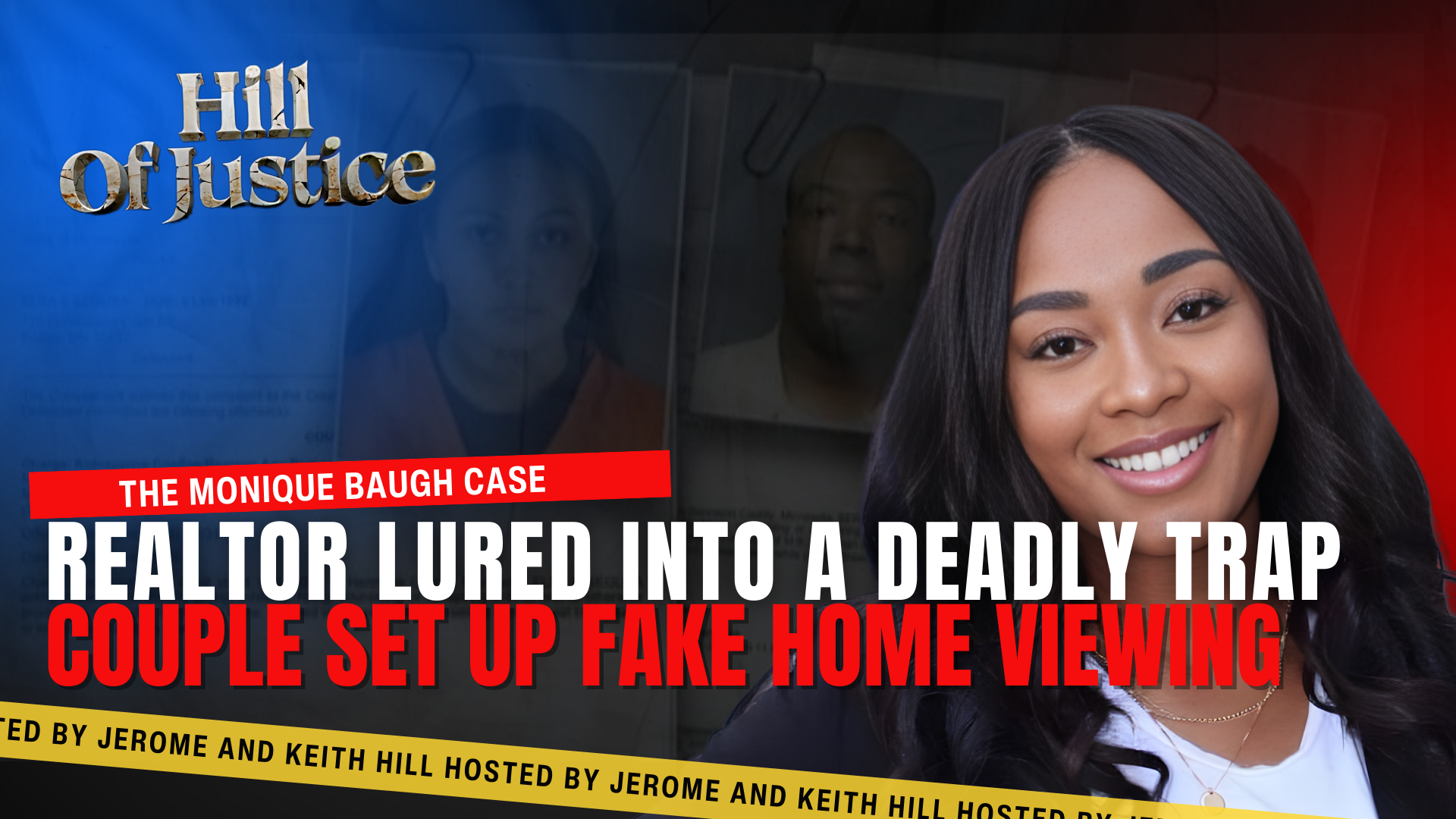

The Maple Grove Real Estate Ambush

This Episode
On New Year’s Eve in Maple Grove, Minnesota, real estate agent Monique Ball thought she was heading to a routine private home showing. Nothing seemed unusual at first. A buyer requested a walk-through. The home appeared legitimate. The appointment was set. But the address wasn’t real. The listing wasn’t real. And the men waiting inside had no interest in purchasing property.
They were waiting for her.
In this episode of Hill of Justice, hosts Jerome Hill and retired Sheriff Victor Hill break down one of the most disturbing ambush cases they have ever analyzed. What looked like a random act of violence quickly unraveled into a carefully structured conspiracy — one built on digital footprints, fake identities, and a violent motive rooted in revenge.
This case stretched across two cities, two shootings, and two trials. A first conviction collapsed, and the truth nearly collapsed with it… until investigators rebuilt the entire case from the ground up.
This is how they did it.
A Target Selected, Not Found
Monique wasn’t randomly chosen. She was selected, and her profession made her vulnerable. Real estate work requires trust — meeting strangers at unfamiliar properties, often alone. The conspirators insisted on a private showing on New Year’s Eve, a day chosen for its isolation and low likelihood of witnesses.
Inside the home, the attackers assaulted, hogtied, and kidnapped Monique, placing her inside a rented U-Haul truck. That U-Haul — and its GPS data — would later become one of the most damning pieces of evidence in the entire case.
The decision to remove her from the home was the conspirators’ fatal mistake. As Jerome explains, moving a body creates distance but not safety. It leaves a trail investigators can follow — and they did.
Digital Evidence That Told the Story
The offenders believed they were being clever. They used:
-
A burner phone
-
A fake address
-
A rented U-Haul
-
A property not listed on MLS
But digital evidence does not blink.
Investigators quickly triangulated:
-
Monique’s cellphone
-
The burner phone
-
The U-Haul’s GPS
-
Traffic and gas-station cameras
Each data point created a structural map of the conspiracy. Even deleted messages were recoverable. Every step they took generated a breadcrumb — and prosecutors followed the entire trail.
As Victor explains, in today’s world you need to “float into a crime scene and float out” to avoid leaving evidence. Cameras, cell data, and digital logs make that nearly impossible.
A Second Shooting Reveals the Motive
After killing Monique, the conspirators weren’t done.
They traveled to her boyfriend’s home — the man the shooter believed had “snitched” on him in a drug case. Instead of confronting the man directly, he chose a path intended to inflict maximum devastation: killing the woman he loved.
The boyfriend survived the attack thanks to his children, who immediately called 911. Their quick action gave investigators precious minutes and clarity that helped tie the two crimes together.
The motive was simple and cruel: revenge through destruction.
A Retrial Exposes the Weakness of the Court System
Despite the overwhelming digital and forensic evidence — including matching shell casings and projectiles found at both scenes — the first conviction did not hold.
In 2021, the Minnesota Supreme Court overturned the conviction of one of the conspirators, ruling that the judge’s jury instructions were not clear enough.
Victor highlights a hard truth:
Courtrooms are political. Evidence does not always determine outcomes. Judges, attorneys, and systemic bias often shape cases in ways the public never sees.
But in the retrial, the structure of the evidence spoke louder than any argument. The digital trail, the GPS logs, the cellphone pings — all of it locked the conspirators into place.
Lessons for Personal Safety
Jerome and Victor emphasize this case isn’t about victim blaming — it’s about teaching survival strategies for people in vulnerable professions:
-
Real estate agents
-
Social workers
-
Travel nurses
-
Anyone meeting strangers at private locations
Essential lessons include:
-
Do not go to private showings on holidays or isolated days.
-
Verify addresses through all MLS systems, including unlisted categories.
-
Share locations with multiple trusted people.
-
Avoid being picked up for a date; arrive in your own vehicle.
-
Document license plates, photos, and vehicle types.
-
Use additional tracking devices not tied to your phone.
These precautions don’t eliminate risk, but they dramatically reduce opportunity for predators.
A Case Built on Structure
What solved this case wasn’t a confession or a witness. It was structure — patterns in movement, data, geography, and behavior.
As Jerome states:
“Your actions create the structure of the crime. It wouldn’t have mattered what they said — the evidence already told the story.”
From the fake listing to the U-Haul to the final shots fired, every decision these men made built the blueprint that ultimately convicted them.
Closing Thoughts
This case is a chilling reminder that predators increasingly use technology, isolation, and deception to lure victims — but technology also exposes them.
Digital evidence doesn’t panic.
It doesn’t forget.
And it doesn’t lie.
As always, the Hills remind viewers to stay aware, stay prepared, and stay informed.
To support the show or check out Hill of Justice merchandise, visit the channel’s official store and subscribe for weekly case breakdowns.

Be the first to leave a comment