
Why Transparency Is Failing the Justice System

This Episode
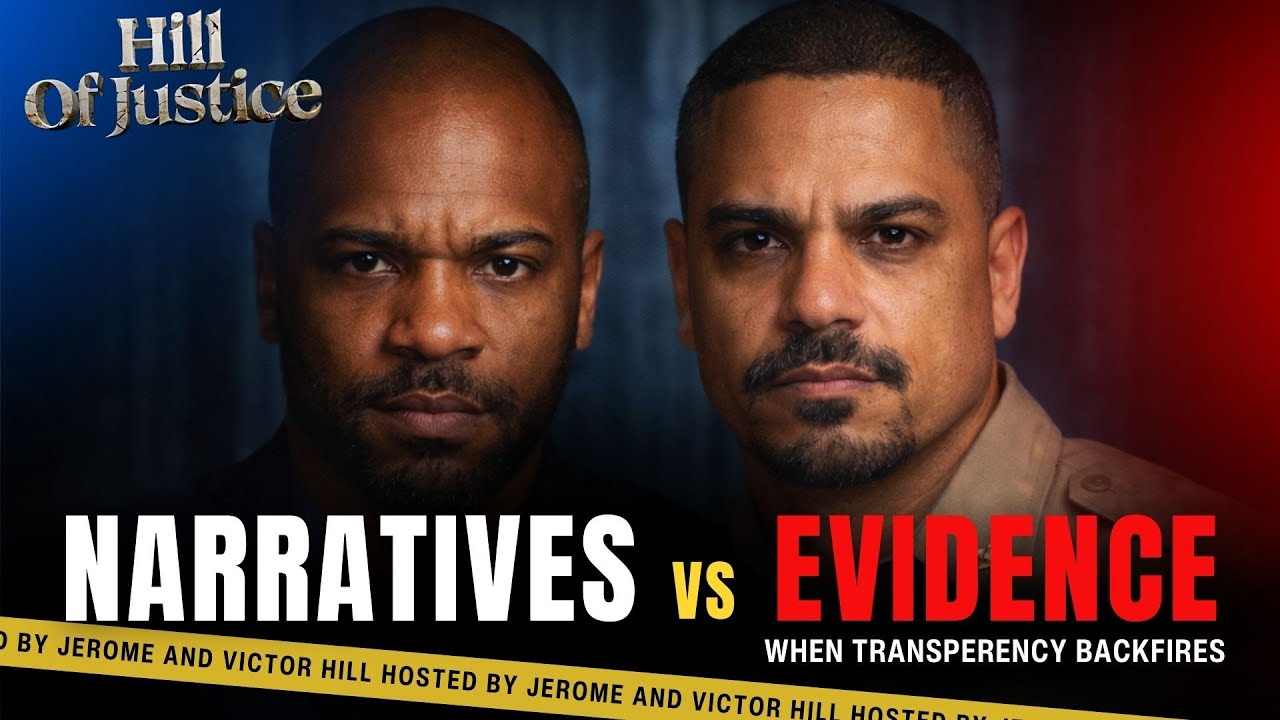
In this episode, the Hill of Justice team tackles the controversial and complex topic of police transparency. Jerome and Victor Hill argue that while accountability is essential, the current trend of releasing raw, context-free disciplinary files is doing more harm than good. They discuss how “policing becomes theater” when narratives replace evidence, and how indiscriminate transparency can destroy good officers while failing to address actual systemic issues.
The Core Issue: Context vs. Raw Data
The hosts identify a critical flaw in how transparency is currently demanded and implemented: the confusion between “visibility” and “truth”.
• The Narrative Trap: Every major police scandal follows a pattern: an incident occurs, outrage follows, and a sentence is passed by public opinion before the facts are fully known. Once the context disappears, a narrative takes over, replacing real evidence.
• Raw Files Deceive: Releasing raw internal files can be misleading. As Jerome Hill notes, if you pulled a veteran cop’s raw file, you might assume they are corrupt due to the volume of complaints, even if those complaints are unfounded.
• The “McDonald’s” Standard: The hosts question why law enforcement is the only profession where internal, unfounded personnel complaints might be made public. They argue that if every private employee (e.g., at McDonald’s or Coca-Cola) had their entire file exposed—including false accusations—nobody would look employable.
Expert Analysis: “Transparency Can Manufacture Corruption”
Jerome and Victor Hill break down the dangers of “Institutional Panic” and political bias within the system.
• The Retaliation Tool: Criminals and disgruntled citizens often “load up” an officer’s file with false complaints as a form of harassment or retaliation for receiving a ticket or being arrested.
• The “Rude” Detective: Jerome Hill shares a personal story where a lighthearted joke he made while canvassing for a murder suspect was misinterpreted as rudeness. A supervisor with a personal bias tried to use that complaint to damage his record, showing how internal politics can distort a file.
• Shifting the Blame: The system has shifted focus from the criminal’s actions to the officer’s reaction. For example, during high-speed chases, the public query has shifted from “Why was that criminal running?” to “Why was the cop chasing him?”. This shift gives criminals a “free pass” while prosecuting officers for doing their jobs.
Key Takeaways & Systemic Realities
1. The “ER Doctor” Analogy
Just because an officer has complaints does not mean they are bad at their job.
• Exposure equals Complaints: The hosts compare active officers to ER doctors, who get sued more than family doctors not because of skill, but because of exposure to critical situations.
• High Activity: Officers who handle the most volatile calls and work in the toughest neighborhoods naturally generate the most complaints. If data isn’t normalized for this context, accountability becomes distortion.
2. Differentiate Between Allegations and Findings
Transparency should not be a “data dump” of every accusation ever made.
• Sustained Misconduct: The hosts agree that sustained findings of serious misconduct—such as excessive force, dishonesty, sexual misconduct, or civil rights violations—must be disclosed because credibility is the backbone of the justice system.
• Protect the Unfounded: Unfounded complaints or minor administrative issues should remain private. Releasing these is equivalent to treating a “not guilty” verdict as a criminal record.
3. The Impact on Public Safety
• Hesitation Kills: When officers fear that standard police work will result in career-ending public scrutiny, they may hesitate to enforce the law.
• The Teacher Analogy: The hosts compare this to the education system, where teachers are blamed for student behavior. When authority figures are stripped of the ability to act without fear of persecution, the environment becomes chaotic and unsafe.
Conclusion
True accountability requires context, not just raw data. The hosts conclude that while bad cops must be removed, the current method of “transparency” often serves as a political weapon rather than a tool for justice. As they state, “Visibility without explanation doesn’t inform the public,” and if investigators are biased or political, transparency doesn’t expose corruption -it manufactures it
Awareness, verification, and layered security are no longer optional-they are essential.
Because the most dangerous knock on the door is often the one you almost trust.
🎧 Listen to the full episode of Hill of Justice
Available on Apple Podcasts, Spotify, iHeartRadio, and all major platforms
📌 Subscribe for unfiltered discussions on law, justice, and real-world safety
📲 Follow @HillOfJustice
🎬 Produced by Juming Delmas Studios
🔗 https://www.jdelmasstudios.com

Be the first to leave a comment