
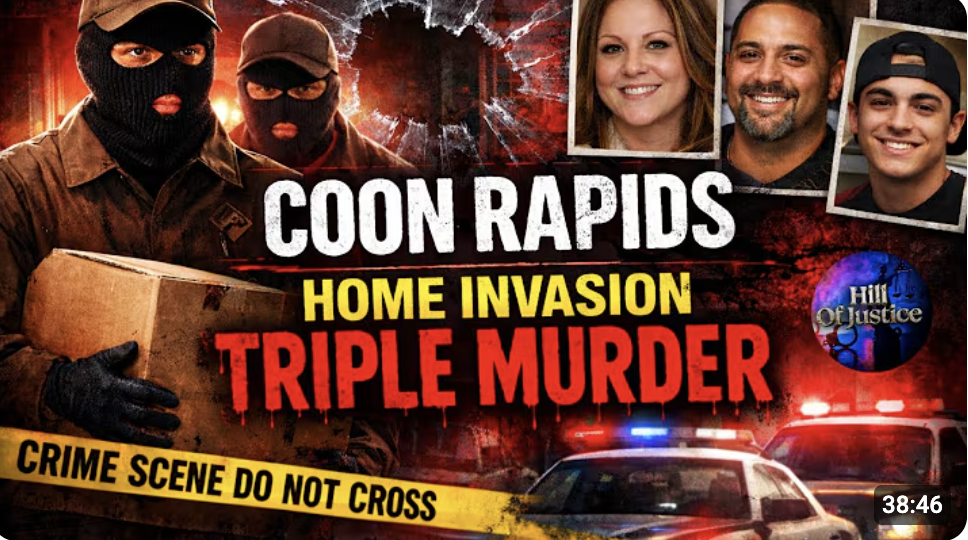
Sometimes the Most Dangerous Knock Looks Completely Normal

This Episode
Danger doesn’t always arrive screaming.
Sometimes it rings the doorbell.
In this episode of Hill of Justice, we break down a case that exposes one of the most unsettling realities of modern crime: how uniforms, branding, and familiarity can be weaponized to bypass instinct, security, and common sense.
A quiet neighborhood in Coon Rapids.
A front door.
Suspects dressed like UPS workers.
What followed was a rapid escalation from routine delivery to a deadly home invasion—unfolding inside a family’s living room.
The Illusion of Safety
We are conditioned to trust uniforms.
Delivery drivers. Utility workers. Service professionals. That trust is exactly what the suspects relied on.
They didn’t force entry immediately.
They approached calmly.
They looked legitimate.
That was the plan.
This case proves that normalcy is sometimes the disguise.
Fake UPS Uniforms and a Violent Entry (00:00–01:12)
Security footage captured the approach.
The suspects wore UPS-style uniforms, moved with confidence, and positioned themselves in a way that lowered suspicion. The door opened—and the situation changed instantly.
Compliance was gained before danger was recognized.
By the time reality set in, the suspects were already inside.
Why This House Was Targeted (10:28)
This was not random.
Hill of Justice breaks down why this specific home became the target:
-
Predictable routines
-
Visible indicators of occupancy
-
Assumptions about safety in a “quiet” area
Targeting starts long before the knock.
Most victims never realize they’ve been selected until it’s too late.
The Red Flags People Miss
There were signs.
Subtle ones—but signs nonetheless.
Uniforms that weren’t quite right.
Behavior that didn’t match normal delivery protocol.
Moments of hesitation that intuition noticed—but logic dismissed.
This episode explains why people talk themselves out of survival instincts—and how criminals depend on that hesitation.
Security Mistakes That Created a Soft Target (16:15)
No home is invincible. But some homes are easier than others.
This case exposed common vulnerabilities:
-
Overreliance on visual trust
-
Lack of layered security
-
No verification protocol before opening the door
Security systems don’t fail all at once. They fail in pieces.
Could the Family Have Saved Themselves? (21:03)
This is the hardest question—and the most important.
Hill of Justice does not deal in hindsight blame. It deals in decision-making under stress.
We analyze what options existed, which ones disappeared fastest, and how seconds—not minutes—shaped the outcome.
Survival decisions are rarely clean. They are fast, emotional, and permanent.
The 911 Call and Police Response (27:40)
When the call finally came in, the damage was already done.
Officers responded to a chaotic, evolving scene with limited information. The episode breaks down response timing, tactical considerations, and what law enforcement can—and cannot—do once an invasion is already underway.
Prevention is always safer than response.
Fight, Flight, and the Reality of Home-Invasion Choices (33:55)
Fight or flight isn’t theoretical.
It’s physiological.
This episode explains how stress shuts down fine motor skills, narrows perception, and forces split-second decisions that are later judged in slow motion.
Understanding this matters—not just for victims, but for families preparing mentally for worst-case scenarios.
Final Breakdown: Awareness Is Protection (37:10)
This case wasn’t shared for shock value.
It was shared so families understand a hard truth: home invasions today don’t always look like threats.
They look official.
They look polite.
They look routine.
Awareness, verification, and layered security are no longer optional—they are essential.
Because the most dangerous knock on the door is often the one you almost trust.
🎧 Listen to the full episode of Hill of Justice
Available on Apple Podcasts, Spotify, iHeartRadio, and all major platforms
📌 Subscribe for unfiltered discussions on law, justice, and real-world safety
📲 Follow @HillOfJustice
🎬 Produced by Juming Delmas Studios
🔗 https://www.jdelmasstudios.com

Be the first to leave a comment